
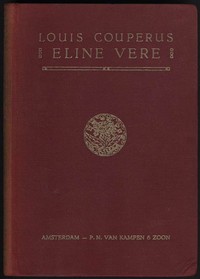
Eline Vere: Een Haagsche roman by Louis Couperus
First published in 1889, Louis Couperus's Eline Vere is often called the first modern Dutch psychological novel. Forget knights and castles—this is a story about the quiet desperation behind fancy curtains and polite society.
The Story
We meet Eline in her late twenties, living with her well-meaning but conventional sister and brother-in-law in The Hague. On the surface, she has it all. But Eline is deeply unhappy, prone to nervous attacks and a crushing sense of boredom. She's engaged to a solid, reliable man, but the thought of a predictable future fills her with dread. She breaks it off, seeking something more exciting, only to find herself just as lost. The story follows her as she moves from one distraction to another—a potential new romance, travel, art—but nothing fills the void. Her moods swing wildly, alienating those who care for her. It’s a slow-motion train wreck where the audience can see the danger ahead, but Eline, trapped in her own mind, cannot.
Why You Should Read It
What amazed me is how modern Eline feels. Couperus doesn't judge her. He shows us her world: a society where women's options were severely limited, and where feelings like hers had no name. She isn't 'crazy'; she's a sensitive person in a world that doesn't fit her. Reading it, you don't just observe her, you feel her claustrophobia. The writing is detailed and immersive, pulling you into the drawing rooms and emotional landscapes of the characters. It’s a masterclass in showing how inner turmoil can be just as gripping as any adventure.
Final Verdict
This book is perfect for readers who love deep character studies and historical fiction that feels relevant. If you enjoyed the psychological depth of Madame Bovary or the social observations of Jane Austen, but wanted something darker and more internal, you'll find a friend in Eline Vere. It’s not a fast-paced thriller; it's a thoughtful, sometimes heartbreaking, look at a soul adrift. Be ready to get thoroughly absorbed in Eline's world and to think about her long after the last page.
This is a copyright-free edition. Share knowledge freely with the world.
Jessica Hernandez
11 months agoAfter a thorough walkthrough of the table of contents, the footnotes provide extra depth for those who want to dig deeper. It cleared up a lot of the confusion I had previously.
John Scott
5 months agoVery interesting perspective.
Anthony Martin
2 years agoRecommended.
William Walker
1 year agoCitation worthy content.



Charles Moore
11 months agoInitially, I was looking for a specific answer, but the author’s unique perspective adds a fresh layer to the discussion. Truly a masterpiece of digital educational material.