
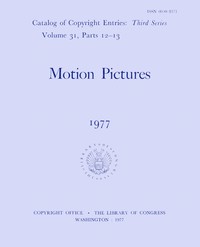
Motion pictures, January-June 1977 : Catalog of copyright entries, third…
Let's be clear: this is not a novel. There is no plot in the traditional sense. 'Motion Pictures, January-June 1977' is a raw, unedited primary source. Published by the U.S. Copyright Office, it's a straightforward listing of every film registered for copyright protection in that six-month window. The entries are bare bones: title, claimant (usually the production company or a producer), and a registration number. It's bureaucracy in book form.
The Story
The 'story' here is the snapshot it provides. The most famous entry is, of course, 'Star Wars' (listed under its full title, 'Star Wars, Episode IV: A New Hope'). But it sits quietly alongside hundreds of others. There are major studio releases you might remember, like 'Annie Hall' or 'The Spy Who Loved Me.' Then there are the curiosities: low-budget horror films, obscure documentaries, 'educational' films with puzzling titles, and what seem to be student projects. The book doesn't judge. It simply records that someone, somewhere, believed their creation was worth legally protecting. The narrative is the sheer volume and variety of attempted storytelling in one moment in time.
Why You Should Read It
You don't 'read' this book cover-to-cover. You explore it. For a film nerd or a pop culture historian, it's a playground. It's a tool for discovery. You can trace the early paperwork for films that became classics, or get obsessed with a strange title and fall down a research rabbit hole trying to find a copy. It highlights the brutal reality of filmmaking: for every iconic hit, there are countless projects that barely left a paper trail. This book is that paper trail. It's humbling and fascinating. It turns the spotlight away from the famous directors and onto the often-invisible act of legal creation.
Final Verdict
This is not for casual readers looking for a bedtime story. It's a reference book, pure and simple. But it's a must-have artifact for serious film researchers, cinema studies students, and pop culture archaeologists. If you love digging through IMDb's deepest pages or get a thrill from finding a forgotten VHS tape at a garage sale, this catalog will feel like a treasure map. It's the ultimate 'what if?' book for Hollywood's most transformative year.
No rights are reserved for this publication. You can copy, modify, and distribute it freely.
Jessica Scott
7 months agoI started reading out of curiosity and the arguments are well-supported by credible references. Highly recommended.
Richard Harris
1 year agoFrom the very first page, the emotional weight of the story is balanced perfectly. This story will stay with me.

Donald White
1 year agoSimply put, the author's voice is distinct and makes complex topics easy to digest. Thanks for sharing this review.