
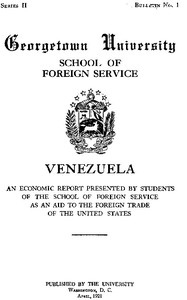
Venezuela, an economic report by Georgetown University. School of Foreign Service
Let's be honest, a university report doesn't sound like a page-turner. But this one reads like the most well-organized, fact-filled explainer you could ask for on a baffling situation.
The Story
This isn't a story with characters, but it has a clear arc. It starts with Venezuela's historic reliance on oil, showing how that one resource shaped everything. The report then walks through the major policy decisions over decades—like nationalizing the oil industry, controlling currency exchange rates, and setting price controls. It shows how each choice, often made to solve an immediate problem, created bigger ones down the line. The plot thickens as it details the spiral: how relying solely on oil revenue left the country vulnerable when prices dropped, how controls led to shortages and a black market, and how inflation eventually went off the charts. The ending isn't happy; it's a stark look at the profound human and social cost of economic failure.
Why You Should Read It
I appreciated how it cuts through the noise. You won't find blame aimed at one political side or another here. Instead, you get a cause-and-effect chain. It helped me understand that an economic collapse isn't a single event, but a series of connected failures. The most compelling part is how it illustrates the 'trap' Venezuela is in—how fixing inflation might make shortages worse, or how ending subsidies could cause immediate hardship. It creates a sense of tragic inevitability, showing why solutions are so agonizingly difficult.
Final Verdict
This is perfect for anyone who likes their current events with deep context. If you're a student of politics, international relations, or economics, it's a masterclass in applied theory. For the general reader who's curious about the world, it transforms a confusing news topic into a comprehensible, if heartbreaking, case study. It's not light reading, but it is exceptionally clear reading. You'll finish it feeling genuinely informed, not just opinionated.
The copyright for this book has expired, making it public property. You can copy, modify, and distribute it freely.
Logan Lopez
10 months agoThe fonts used are very comfortable for long reading sessions.
Sarah Jones
9 months agoCompatible with my e-reader, thanks.
Joseph Rodriguez
10 months agoEssential reading for students of this field.
Dorothy Harris
1 year agoBased on the summary, I decided to read it and the character development leaves a lasting impact. I will read more from this author.



Susan Lopez
3 months agoThe clarity of the introduction set high expectations, and the transition between theoretical knowledge and practical application is seamless. A perfect balance of theory and practical advice.